Workshop with HeyCounsel: what small law firms say about their practice management software in 2026
We ran a workshop for the HeyCounsel community on September 22. Members told us what intake actually costs them, what their current software gets wrong, and what they would want instead.

Diana Khramina
Praxis
Co-founder
HeyCounsel is a community for solo, boutique and fractional lawyers, built on the idea that independent should not mean alone. On September 22 we ran a workshop for their members: a live demo of Praxis, then questions.
The demo is the part we planned. The useful part was what members said about the software they run their practice on today.
What small firms say about their practice management software
Intake takes 20 to 60 minutes per client, and none of it is billable. Attendees put their own intake at 20 to 25 minutes. One firm said 30 to 60. That is per inquiry, before any legal work starts, and it is spent moving the same facts between a form, an email thread, a calendar and a billing system.
The tools are not loved. Attendees running Clio and PracticePanther were candid about being unhappy with them. The complaints were consistent: the software has become clunky, and the data does not connect, so the same client information is re-entered in several places.
Conflict checks are often still manual. One firm runs them by emailing the other lawyers and asking. It works at their size, and they know it will not keep working. The practice management system they pay for is not the thing doing the check.
Billing is where integration matters most. Firms generate bills in their practice management tool and expect them to land in QuickBooks. That chain already works. Anything new has to respect it rather than ask a firm to rebuild its accounting on day one.
The pattern underneath all 4: firms are not looking for another place to type. They want the work between an inquiry arriving and a matter opening to happen on its own, and they want it connected to how they already get paid.
What we showed
Praxis handles the administrative work wrapped around the client journey: intake, qualification, conflict checks, scheduling, engagement letters, invoicing and document collection. The lawyer supervises and approves.
We walked through a single inquiry from end to end. A new lead arrives by email. The agent reads it, drafts a reply and offers consultation times, but only from the hours the lawyer has released to it, never the whole calendar. While that draft waits for approval, the agent runs 2 checks in the background:
a qualification report against the firm's own acceptance rules, with background on the company and the request;
a conflict check against existing matters and past contacts.
The lawyer reviews both, sends the reply, and books the consultation from the same screen once the client picks a time. In the demo that took about 2 minutes.
After the consultation, the engagement letter is pre-drafted from the firm's own template, with the invoice attached. The lawyer checks the terms and the fee, hits send once, and both go out together for signature and payment. When the invoice is paid, the matter opens.
Nothing leaves the firm without a lawyer approving it. The whole walkthrough, from inquiry to signed engagement letter, took under 10 minutes on screen.
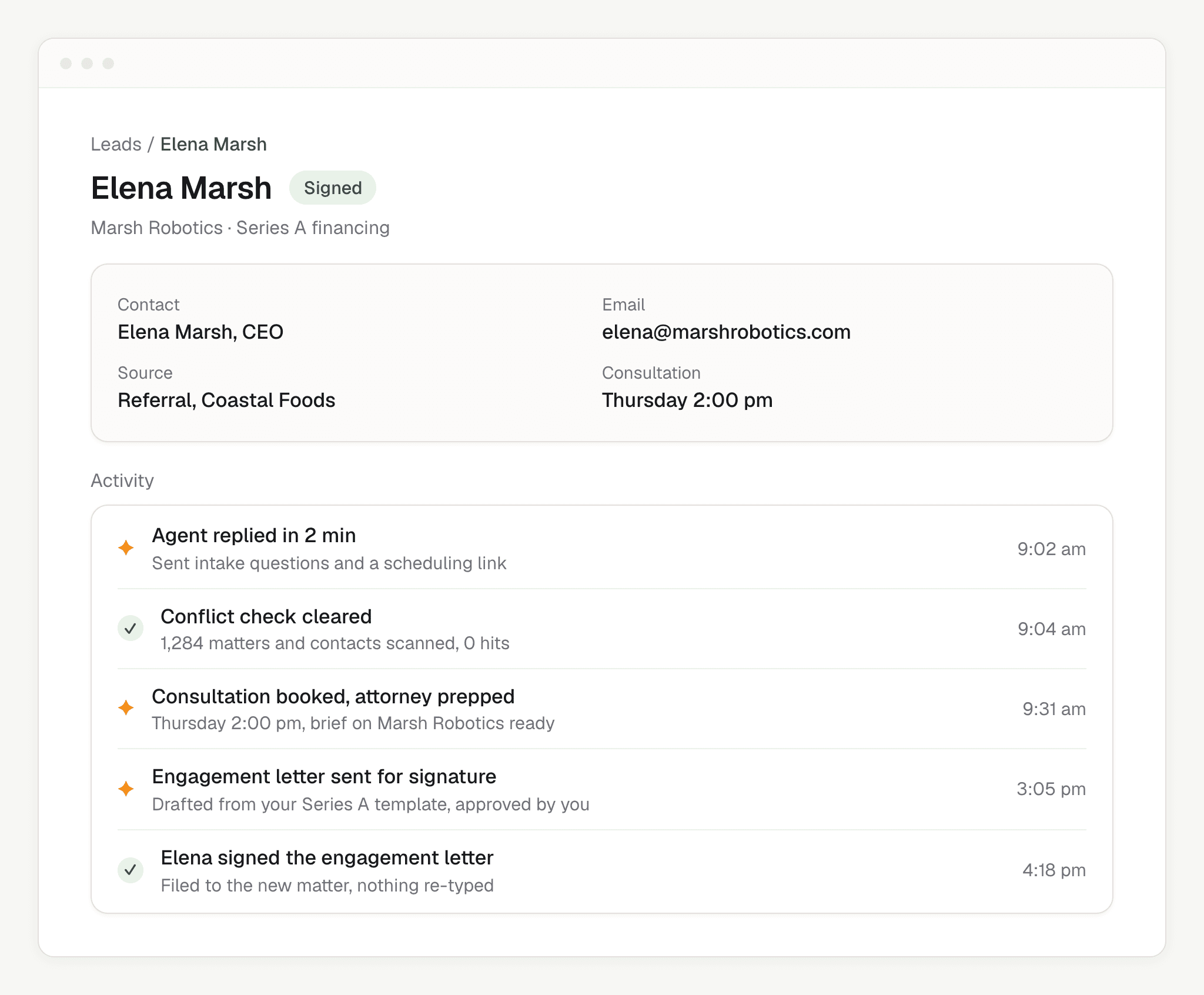
One inquiry, start to finish, with the lawyer approving each step.
What exists today
Available now: client portal, matter management, document classification and drive integration, a manual timer, and QuickBooks. Firms that want to keep Clio for matter management can do that, and Praxis pushes lead and client data across to it.
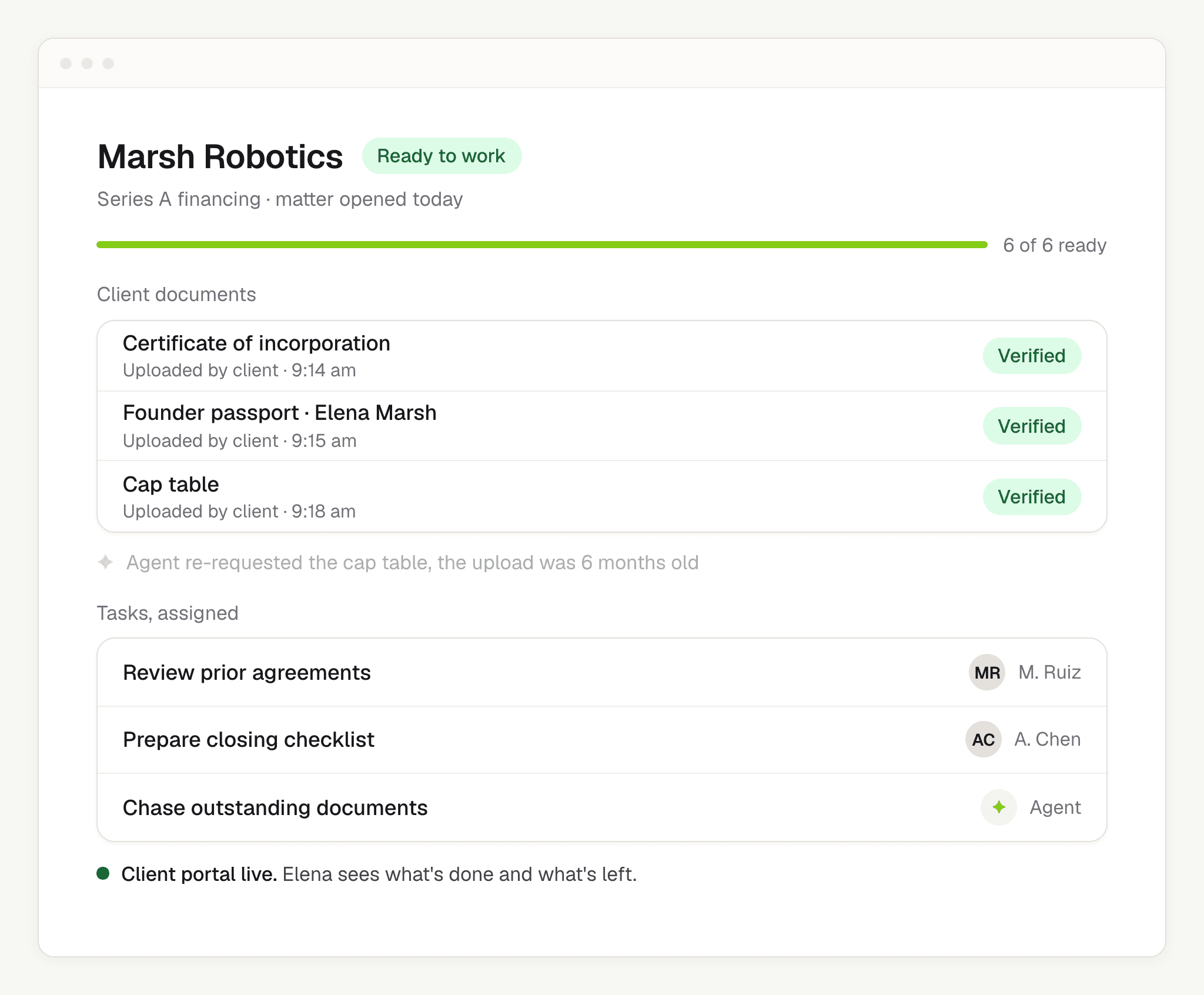
Documents collected and verified, tasks assigned, and a portal the client can see.
Onboarding is hands-on rather than self-serve. We start with the workflow that hurts most, usually intake or billing, configure it around the firm's own templates and rules, and move the rest across from there.
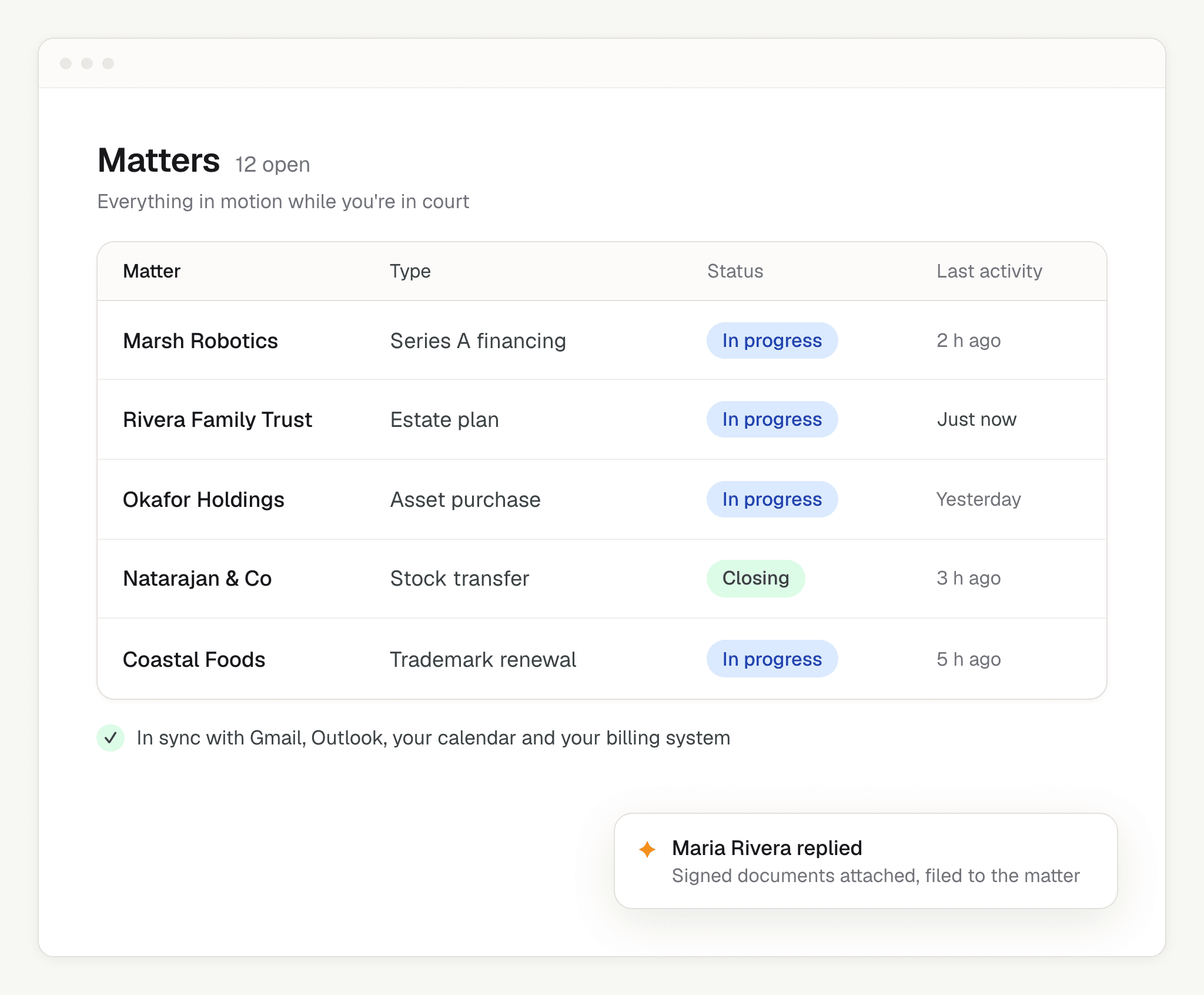
Matters stay in sync with email, calendar and the firm's billing system.
Questions from the room
4 questions came up. Here are the answers in full.
Can Praxis replace Clio, or is it built to work alongside it?
It depends on the pace you want. Praxis already covers client portal, matter management, document classification and drive integration, and the direction is an AI-native alternative to Clio for law firms.
The usual path is incremental: start with your most painful workflow, usually intake or billing, then move Clio workflows over one by one. A full migration upfront is possible, but it costs more and puts more load on the firm.
What billing, payment and accounting integrations exist? Can we keep trust and operating funds separate?
Praxis sits on top of your existing payment setup rather than replacing it. If you already process payments through Clio or LawPay, you keep that provider and Praxis handles the billing layer on top: invoices, time entries and matter-level billing.
Firms connect their own bank accounts, so trust and operating funds stay in separate accounts. QuickBooks integration is available today.
Is there timekeeping, and can time be captured automatically?
A manual timer is available today. Automated time capture is in development. The main design constraint is security, specifically avoiding broad screen-data collection.
How does onboarding work?
We do a hands-on onboarding right now, not self-serve. Praxis runs a kickoff to identify your priority workflows and configure the setup. Onboarding and migration typically take about 4 sessions over a few weeks.
Thank you to Brian Scherer and the HeyCounsel community for having us, and to everyone who asked a question.

FAQ
Questions
answered.
Still curious?
How long does client intake take at a small law firm?
Commonly 20 to 60 minutes per inquiry. Most of that is not legal work: it is moving the same facts between a form, an email thread, a calendar and a billing system. It is almost never billable, so it comes directly out of the time available for client work.
Should a firm replace its practice management system all at once?
Rarely. A full migration upfront costs more and puts the heaviest load on the firm at the moment it understands the new system least. Moving the most painful workflow first, usually intake or billing, lets the firm judge the tool on real work before committing the rest.
How long does it take to migrate a small firm to new practice management software?
A workflow-by-workflow migration usually takes about 4 working sessions over a few weeks, with the firm's own templates, acceptance rules and matter types configured as each workflow moves. A single cutover looks faster on paper and is often slower in practice, because the reconciliation happens after go-live.
Can billable time be captured automatically?
Only partly. Timers and calendar or document activity can suggest entries, but fully automatic capture usually depends on monitoring screen activity, which raises confidentiality problems in a law firm. The safer design is suggested entries a lawyer confirms, not silent capture.
How should a law firm keep trust and operating funds separate?
In separate bank accounts held by the firm, with the billing software connected to each rather than holding the money itself. Retainers go to the trust account and earned fees to the operating account. Software should record which is which and leave the judgment to the firm.